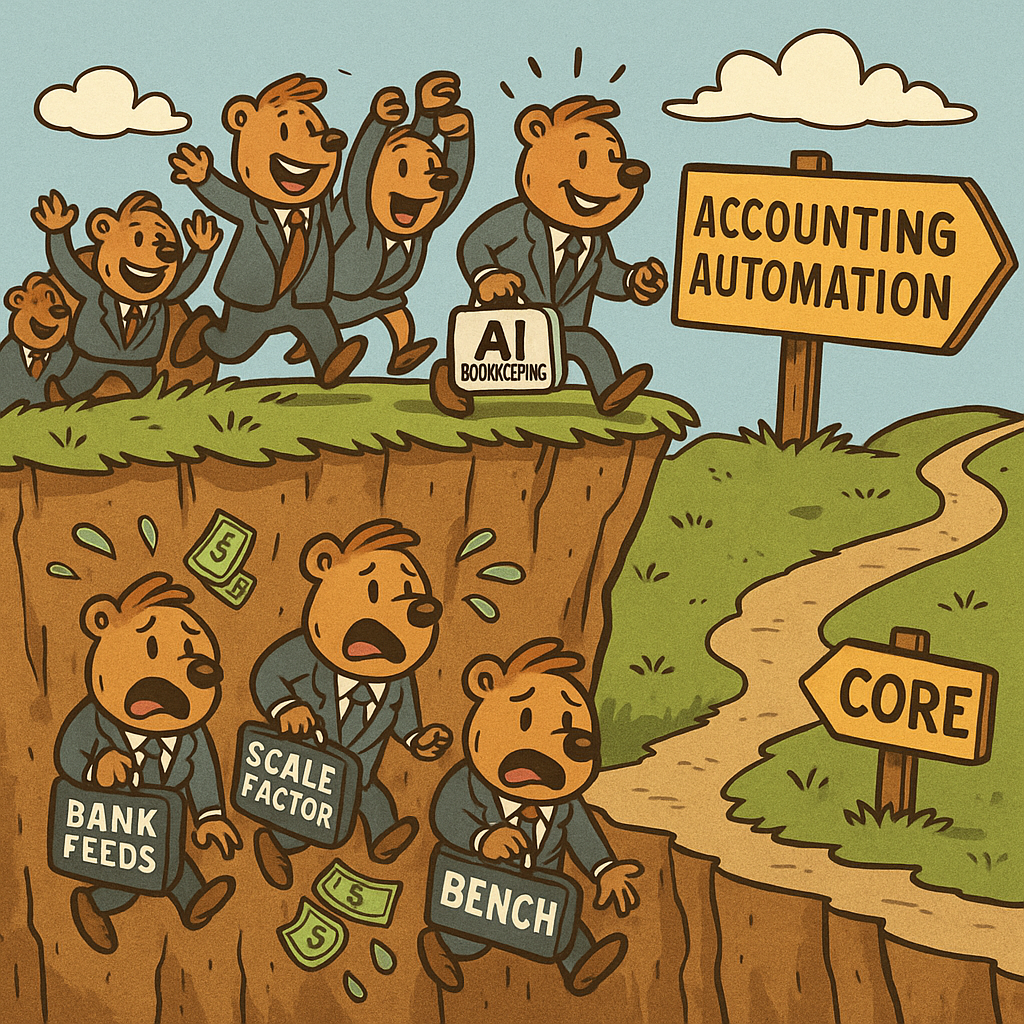
The Future of Bookkeeping: The Bookkeeping Industry’s Big Problem
For decades, bookkeeping has been treated as a necessary but unprofitable task—either left to business owners using entry-level software like QuickBooks or outsourced to firms that rely on outdated, inefficient methods. The emergence of fintech bookkeeping startups promised automation and ease, yet they continue to fail spectacularly.
Why? Because they misunderstand the fundamental challenges of bookkeeping at scale.
Recent collapses, like Bench Accounting, which raised over $100 million before shutting down, prove that even well-funded companies struggle to solve the bookkeeping problem. ScaleFactor and others met similar fates. The reason is simple: these companies failed to recognize that bookkeeping is not just about bank feeds and automation—it requires deep accounting expertise and purpose-built technology.
Actuarius was founded to fix what everyone else has been getting wrong.
Here’s how:
Where Others Failed
1. They Over-Relied on Bank Feeds
Startups like Bench depended heavily on Plaid, Yodlee, and other bank feed technology to automate transaction categorization. But bank feeds alone are not enough—real-world accounting requires context, verification, and adjustments.
2. They Lacked a Proprietary General Ledger
Bench and ScaleFactor tried to scale using existing accounting software (QuickBooks, Xero), rather than developing a purpose-built solution. This increased costs, reduced automation potential, and created inefficiencies.
3. They Had No Institutional Bookkeeping Experience
Most fintechs in this space were led by tech entrepreneurs, not accountants. They didn’t understand the real-world complexity of third-party bookkeeping, leading to flawed assumptions and unsustainable models.
4. They Burned Through Cash Without Profitability
Despite massive venture capital funding, these companies never figured out how to make bookkeeping profitable. High customer acquisition costs, labor-intensive processes, and low margins doomed them.
How Actuarius is Different
1. CORE: A Purpose-Built Accounting Platform
At Actuarius, we didn’t start with existing accounting software—we built CORE, our own proprietary platform designed specifically for third-party bookkeeping. This means:
- Half the records compared to conventional accounting systems.
- Full automation with built-in controls and reconciliations.
- Two-lane transaction structure that eliminates inefficiencies.
2. Deep Institutional Expertise
Unlike fintech startups, we have real-world, institutional third-party bookkeeping experience. I personally learned bookkeeping in CPA firms before QuickBooks even existed, giving us insights that modern accountants and tech founders simply don’t have.
3. A Proven, Profitable Model
While others burned through millions without turning a profit, we built a sustainable, high-margin bookkeeping model. Our tech reduces bookkeeping time by 75-90%, allowing us to generate real profits at a fraction of the cost.
4. A Scalable Future
With CORE, we’re positioned to scale bookkeeping services the way payroll was automated decades ago. Our technology bridges the gap between small business accounting software and expensive ERP systems, offering a true next-generation solution for bookkeeping.
Final Thoughts
The collapse of Bench is just the latest example of how big money alone can’t fix broken business models. The future of bookkeeping belongs to those who combine deep industry knowledge with purpose-built technology—and that’s exactly what Actuarius has done.
We’re not just filling a gap left by failed startups—we’re redefining the industry.
Are you ready for the next generation of bookkeeping? Let’s talk.