Most people think payroll is complicated.
In reality, payroll is one of the clearest examples of how money moves. Every two weeks, the same sequence happens:
- You earn income
- Taxes are withheld
- Benefits are deducted
- Net pay arrives in your bank account
Simple in concept. Yet most financial systems manage to make this straightforward process confusing. Why? Because the pieces are scattered.
- The payroll provider shows the paystub.
- The bank shows the deposit.
- Your tax return shows the W-2 months later.
Each system does its job well, but none of them show the full path. The connections between those numbers are left for the reader to figure out.
That’s where clarity breaks down.
What Happens When You Preserve the Motion
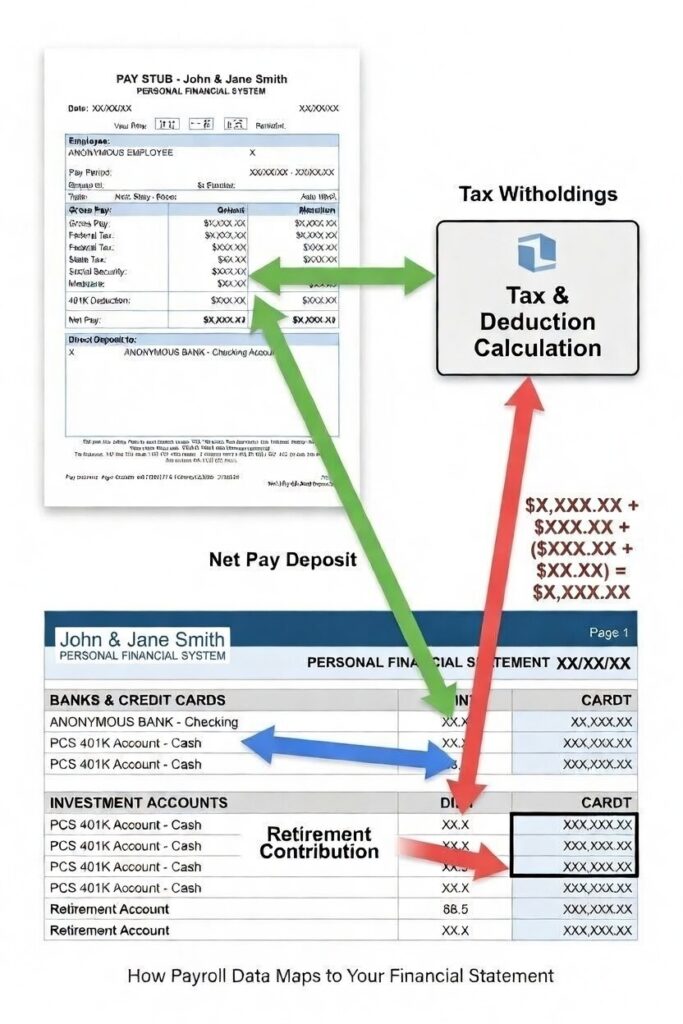
Instead of summarizing payroll, we capture it exactly as it appears on the paystub. Every component is entered using the same structure each time:
- Gross wages
- Tax withholdings
- FICA and Medicare
- Employee benefits
- Employer-paid benefits
- Net pay deposited to the bank
Once entered, the system connects those pieces automatically.
- Gross wages flow into the income section.
- FICA and Medicare appear directly beneath the wages they came from.
- Income tax withholding shows up in the tax section of the financials.
- Net pay ties directly to the deposit in the bank account.
Nothing is lost. Nothing is summarized away. The entire path of the paycheck remains visible.
The Moment People See It
When clients first see this structure, something interesting happens. They recognize their own numbers.
The paycheck they receive every two weeks suddenly appears inside the financial system in a way that mirrors what they already understand. Gross pay. Taxes. Net deposit. The financial reports stop being abstract. They become a map of the client’s own money. That recognition is where real understanding begins.
Why This Matters for Businesses
In a small business, payroll is usually the largest recurring expense. Owners often look at financial statements and wonder: “Where did all the payroll money go?”
When payroll is summarized into a single number, the answer is hard to see. When the full structure is preserved, the path becomes obvious: Wages → taxes → benefits → cash paid.
Once that motion is visible, payroll stops being mysterious.
Why This Matters for Personal Financial Systems
The same principle applies to personal finances. For many households, the paycheck is the starting point of their financial world. Understanding how gross income flows through taxes, benefits, and into spendable cash helps people see:
- how much they actually earn
- how much goes to taxes
- how much they are saving
- what reaches their bank account
That single chain explains a large portion of a person’s financial life.
A Different Way to Think About Accounting
Traditional accounting tends to summarize transactions as quickly as possible. The intention is efficiency. But summarization often destroys something important: pattern recognition.
When the structure of transactions is preserved and repeated consistently, the system becomes easier to understand, easier to audit, and easier to automate. More importantly, it becomes easier for the reader to recognize their own financial activity inside the reports.
Financial Clarity Starts With Motion
Money is not static. It moves. From employer to employee. From wages to taxes. From gross pay to net deposit.
When financial systems preserve that motion instead of compressing it into summaries, something powerful happens. People begin to see how their money actually moves. And once they see that clearly, better decisions usually follow. Often, the first place that clarity appears is the paycheck.
That’s why payroll is where financial clarity begins.