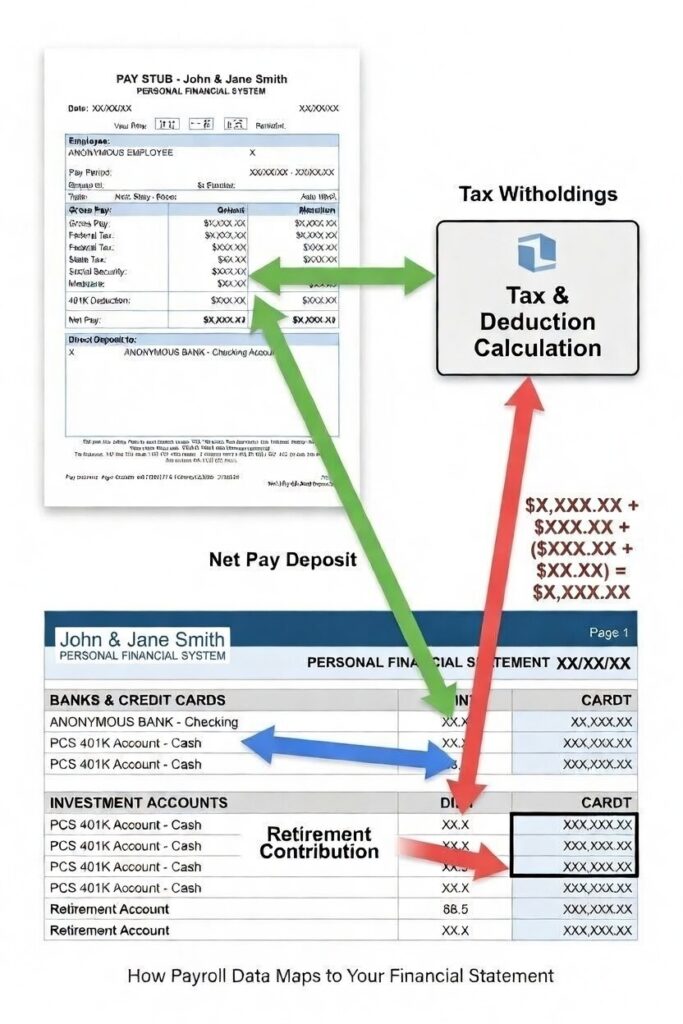
Money is always moving. Payroll moves. Taxes move. Cash moves between accounts. Credit cards, loans, and investments are constantly changing.
Yet most financial systems treat money as if it were static. Every month the motion is frozen into reports -income statements, balance sheets, tax returns.
Those reports are accurate, but they often leave the reader wondering: “How did we get here?” The story of how money actually moved has been compressed into summaries.
The Problem We Set Out to Solve
Years ago, while working with small businesses, we noticed something simple but important. The financial problems we solved this month would appear again next month. So instead of solving them manually every time, we began building systems that preserved the structure of financial activity.
The goal was simple: make the next cycle faster, clearer, and easier to understand.
Over time, something became obvious. Money isn’t a collection of isolated transactions. It’s a continuous flow. Understanding that flow is the key to understanding the numbers.
The Missing Ingredient: Visibility
A retired CPA once explained why he avoided bookkeeping work. He said the biggest problem was a lack of visibility. You could open a client’s accounting system and still struggle to understand what was actually happening. One overlooked detail could undo hours of work.
That insight stuck with us. Accurate numbers are important. But without visibility into how money moves, even accurate numbers can be confusing.
When Motion Becomes Visible
When financial motion is captured and organized properly, something interesting happens. People recognize their own financial activity inside the reports.
- A paycheck becomes wages, taxes, and a bank deposit.
- A transfer between accounts appears exactly where it belongs.
- Expenses line up with the decisions that created them.
The reports stop feeling abstract. They become a map of the client’s financial world. That’s the moment the lights come on.
A Different Way to Think About Accounting
Most accounting systems focus on producing reports. Our focus is different. We focus on preserving financial motion and making it visible. Once that motion is clear, the reports begin to explain themselves. Clients start recognizing their own numbers. And when that happens, something powerful occurs. People understand their financial world.
Power to the People
Understanding your finances should not require a specialized degree. These are your numbers. Your business. Your financial life.
When the system is designed correctly, you should be able to understand every line on your financial reports. In fact, many of our clients eventually understand their numbers better than their CPA. Not because accounting is simple. But because financial motion, when made visible, becomes surprisingly easy to follow.
The Idea Behind Actuarius
At its core, Actuarius exists for one reason: to make financial motion visible.
When people can clearly see how money moves through their business or their financial life, understanding follows. And when understanding improves, better decisions usually follow as well.
That’s what the work has always been about.