Higher Education: Fool’s Gold for the Modern Entrepreneur
The Illusion of Value
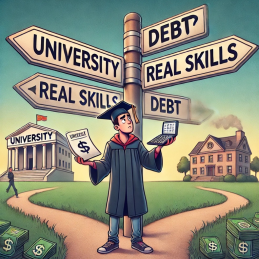
For decades, we’ve been sold a dream: go to college, get a degree, and you’ll have a successful career. The reality? Too often, higher education is nothing more than fool’s gold—a shiny promise that leads students into massive debt without delivering real world skills.
I Learned Everything I Needed by 8th Grade
Looking back, I realize that everything I use in my practice today, I learned in 8th grade. Algebra, logic, problem-solving—those are the skills that matter.
At KU, I was a math whiz and almost switched majors my senior year. My quantitative methods professor convinced me to finish my accounting degree since I was so close. In hindsight, he was right. But everything I learned in higher math—statistics, calculus, quantitative methods—is long gone. I never used it.
I don’t regret learning those things, but they were academically interesting, not practically useful. They didn’t make me money. They didn’t build my business. They didn’t teach me how to think like an entrepreneur.
Universities Are Anti-Change Agents
Higher education isn’t designed to teach adaptability, problem-solving, or business survival. It’s built on conformity and outdated thinking.
When I realized computers would change accounting, I went back to KU to take the core curriculum of a computer science degree. It took about two weeks to see it was a mistake. They were behind the curve. Nothing I learned there was ahead of what was already happening in the real world. Academia wasn’t leading innovation—it was trailing it.
And this is the problem: Colleges teach what worked yesterday, not what works today.
The Debt Trap and The Myth of College = Success
- Tuition has skyrocketed while salaries haven’t kept up.
- Degrees don’t guarantee jobs, yet people still rack up six-figure debt for them. • Most degrees don’t teach real-world skills—just academic theory.
If universities prepared students for success, we’d see fewer financial messes, better-run businesses, and more innovation. Instead, we see graduates drowning in debt, armed with knowledge they’ll never use.
Entrepreneurship Can’t Be Taught in a Classroom
Entrepreneurship isn’t something you study—it’s something you survive.
Real entrepreneurs don’t follow a syllabus. They throw the playbook out the window and figure it out.
Colleges reward:
🚫 Conformity—Entrepreneurs break the rules.
🚫 Following a set path—Business is unpredictable.
🚫 Giving the “right” answers—In real life, there are no right answers.
If you really want to be an entrepreneur, skip the degree and start building. Your best education will come from trial and error, making payroll with $5 in the bank, and learning how to sell something people actually want.
What Real Education Should Look Like
If I were to design an education that actually prepared students for the real world, it would look nothing like a traditional university. It would be:
✅ Apprenticeship-based—Work under real entrepreneurs, not professors.
✅ Failure-driven—Students should start businesses, fail, and learn.
✅ Focused on real-world problem-solving, not theory.
✅ Teaching how to think, not just memorizing outdated models.
Final Thought: Higher Ed Needs a Wake-Up Call
University learning has its place, but it’s not the golden ticket it’s made out to be. For many students, it’s a high-cost detour away from real success.
Maybe it’s time to stop pushing kids toward degrees and start pushing them toward skills.
What do you think? Is higher education still worth it, or has it become an expensive illusion?